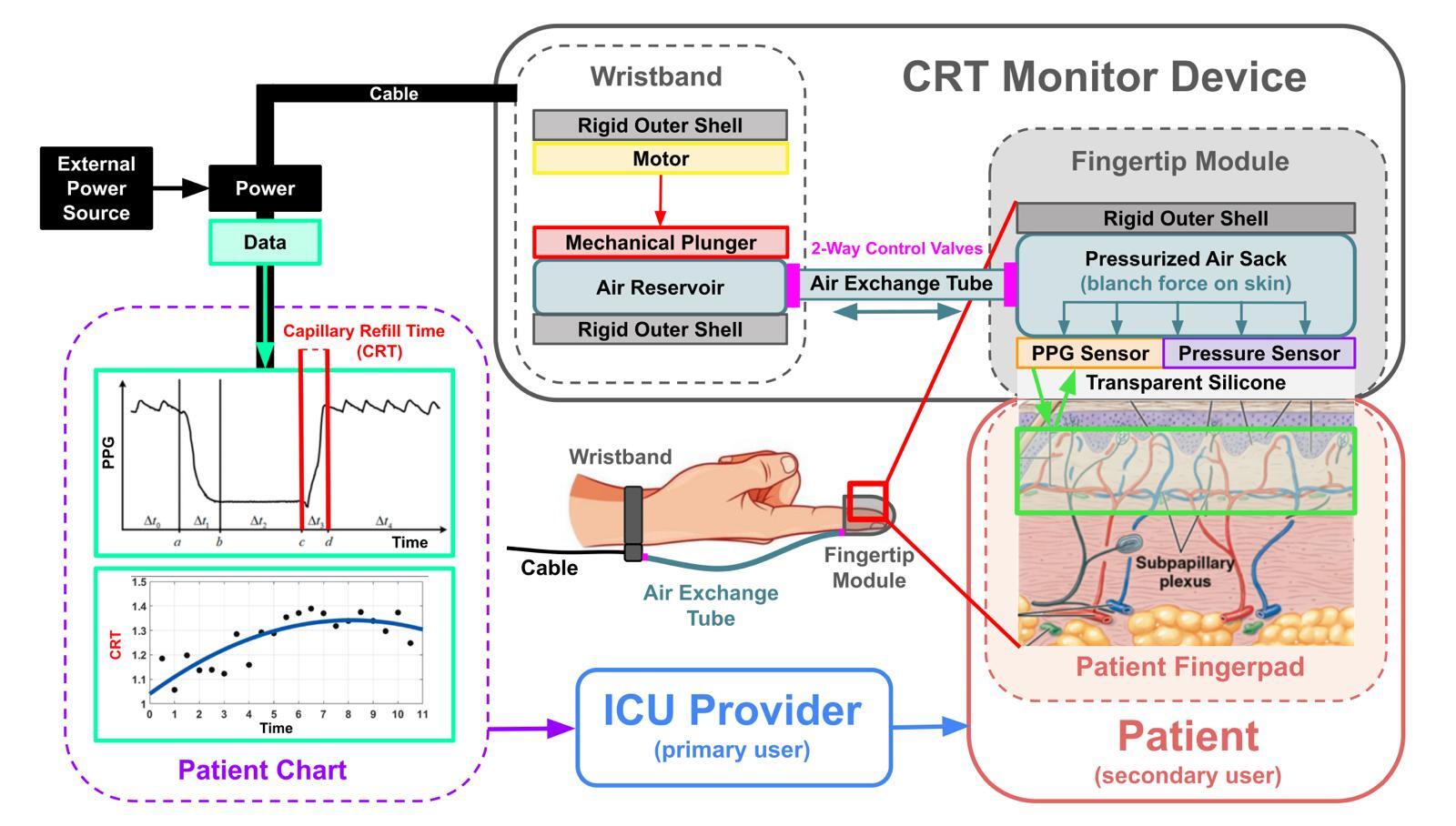
Overview
Capillary refill time (CRT) is a fast bedside indicator of perfusion, but it is usually measured by eye, so results vary from clinician to clinician. For my Georgia Tech Master of Biomedical Innovation and Development (MBID) capstone, my team developed a device concept that measures CRT objectively, taking it from clinical user needs through concept selection, prototyping, and regulatory and business planning.
The CRT Monitor (CRTM) was designed to be used to continuously measure CRT on a patient’s finger to provide a quantitative and trackable value for peripheral perfusion, especially for the purpose of aiding in the early diagnosis of conditions that affect the microcirculatory system (including systemic shock), particularly in patients at a higher risk for developing these conditions in the hospital.
My role: Design controls, Regulatory Strategy, IP Strategy, Prototype Development (Mechanical & Hardware)
Outcome: Our teams was able to develop a working prototype and exact a comparatability study, collected CRT time data from the device and from the ANDROMEDA-SHOCK-2 trial protocol method on 6 subjects, as the basis for a non-inferiority/comparability analysis.
The image below is our final works-like prototype.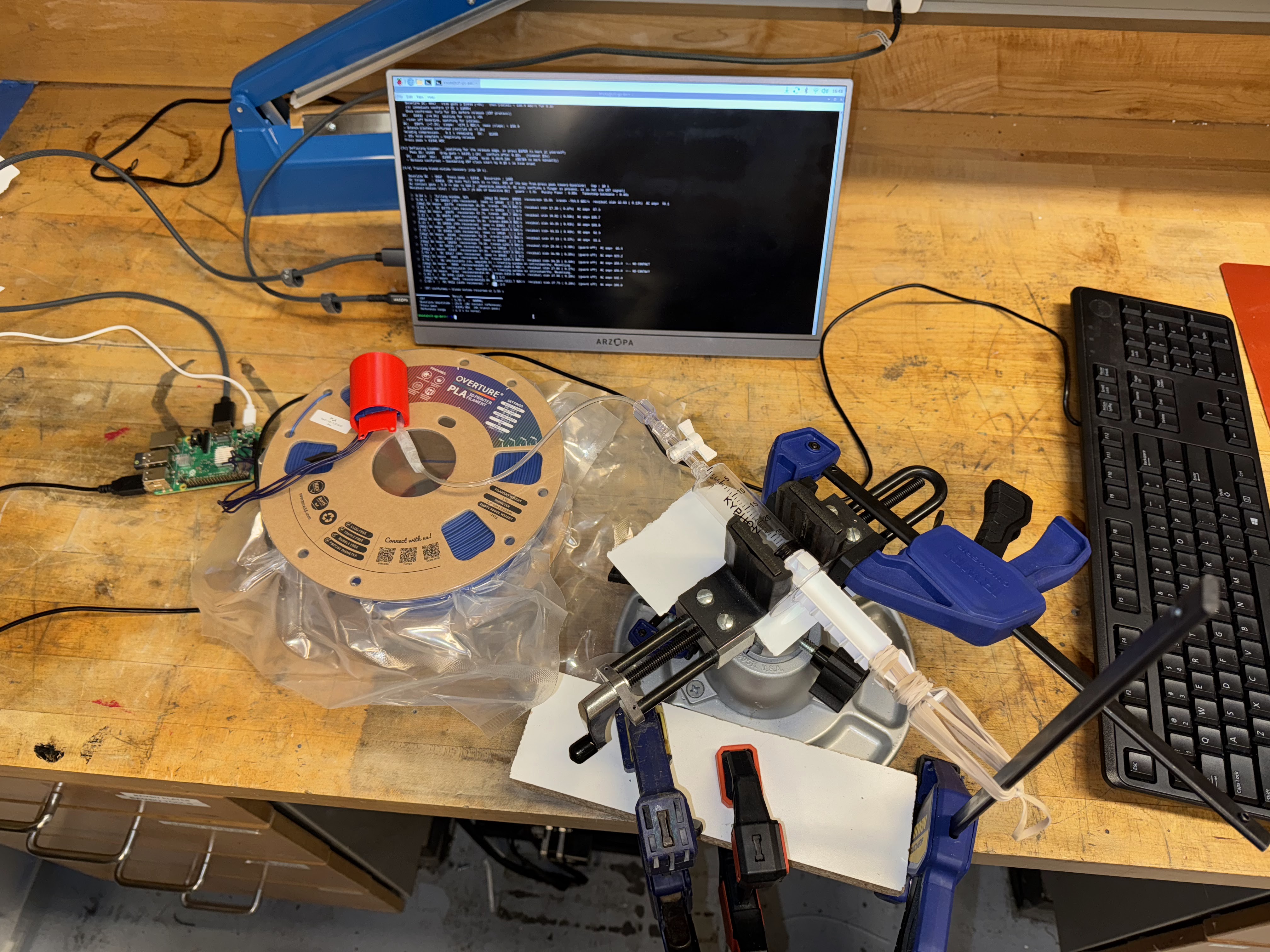
Defining the Problem with Clinicians
I worked closely with clinicians in a solid-organ transplant ICU to define user needs and turn them into system requirements. Those requirements drove every later decision, from the sensing approach to the design controls.
- 50+ clinicians/researchers/industry experts interviewed
- Top user needs included cross-contamination prevention, accuracy of the solution, and the need for an inclusive design.
Concept Development and Design Tradeoffs
To choose between architectures, I used a Pugh matrix framework to compare concepts against weighted user needs. I built interactive dashboards to make the timeline and tradeoffs easy to follow, and used them in our MBID Phase Gate 2 presentation.
- Concept Development Timeline: shows how the concepts evolved and narrowed
- Detailed Design: compares concepts and design tradeoffs side by side
Click here to Launch the Concept Development Timeline Dashboard
Click here to Launch the Detailed Design Dashboard
Prototyping and Testing
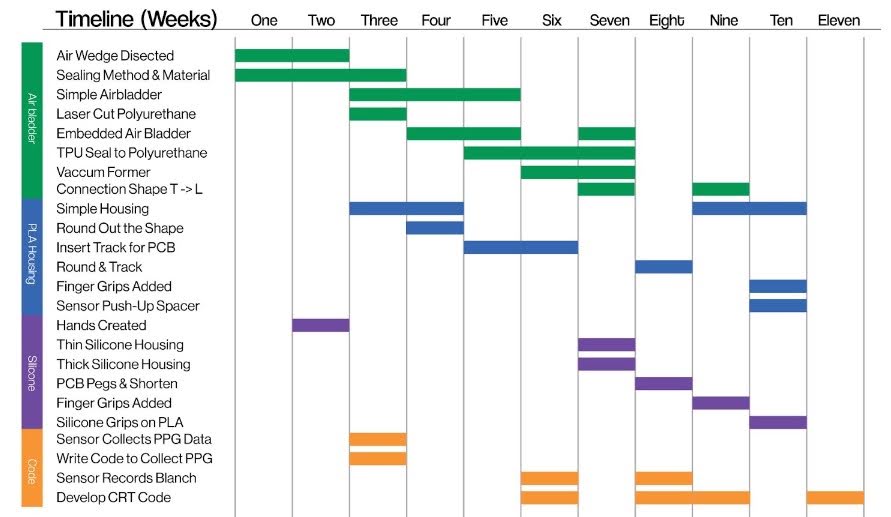
- Optical sensing: built a Raspberry Pi-based PPG dashboard using a MAX30101/MAX30102 sensor and beat-amplitude recovery logic for CRT measurement.
- Pneumatic cuff: designed a force-sensing cuff system, supported by engineering calculatoions for pressure-force relationships.
This video outlines what a final iteration of our team’s CRT Monitor would look like.
Design Controls and Regulatory Strategy
- Built the Design History File (DHF), including design traceability matrices, design controls, manufacturing protocols, and testing strategies.
- Mapped regulatory pathways: De Novo / 510(k) split-predicate strategy, CE Mark, and Health Canada.
- Assessed the IP landscape: passive bladder and PPG provisional patent, freedom-to-operate review, and PCT strategy.